


| ELISA kit |
| Clinical diagnosis |
| Trfia |
| ANTIBODIES |
| CLIA kits |
| Proteins |
| New Products |
| > Human |
| > Canine |
| > Bovine |
| > Equine |
| > Fish |
| > Mouse |
| > Rat |
| > Chicken |
| > Porcine |
| > Rabbit |
| > Goat |
| > Simian |
| > General |
| > Cavia |
| > Caprine |
| > Sheep |
| > Cattle |

Recombinant Human S100A7

Instruction Manual!
| Product name: | Recombinant Human S100A7 |
| Source: | E. coli |
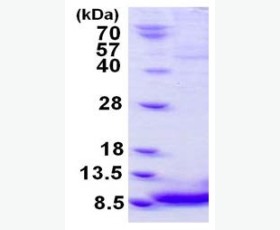
| Purity: | Greater than 95% as determined by reducing SDS-PAGE. |
| Buffer Formulation: | Lyophilized from a 0.2 μm filtered solution of PBS, pH7.4. |
| Applications: | Applications:SDS-PAGE; WB; ELISA; IP. |
| Storage: | Avoid repeated freeze/thaw cycles. Store at 2-8 oC for one month. Aliquot and store at -80 oC for 12 months. |
| UOM: | 100ug/50ug/200ug/1mg/1g |
| Source | E. coli |
| Description | Recombinant Human S100A7 is produced by our E.coli expression system and the target gene encoding Met1-Gln101 is expressed. |
| Names | Protein S100-A7; Psoriasin; S100 calcium-binding protein A7; S100A7; PSOR1; S100A7C |
| Accession # | P31151 |
| Formulation | Lyophilized from a 0.2 μm filtered solution of PBS, pH7.4. |
| Shipping |
The product is shipped at ambient temperature. |
| Reconstitution |
Always centrifuge tubes before opening. Do not mix by vortex or pipetting. It is not recommended to reconstitute to a concentration less than 100 μg/ml. Dissolve the lyophilized protein in ddH2O. Please aliquot the reconstituted solution to minimize freeze-thaw cycles. |
| Storage |
Lyophilized protein should be stored at < -20°C, though stable at room temperature for 3 weeks. Reconstituted protein solution can be stored at 4-7°C for 2-7 days. Aliquots of reconstituted samples are stable at < -20°C for 4 months. |
| Purity |
Greater than 95% as determined by reducing SDS-PAGE. |
| Endotoxin | Less than 0.1 ng/µg (1 IEU/µg) as determined by LAL test. |
| Amino Acid Sequence |
MSNTQAERSIIGMIDMFHKYTRRDDKIEKPSLLTMMKENFPNFLSACDKKGTNYLADVFEKKDKN EDKKIDFSEFLSLLGDIATDYHKQSHGAAPCSGGSQ
|
| Background | S100A7 is a 11-12 kDa member of the S100 family of EF hand calcium binding proteins. Human S100A7 shares 32% amino acid sequence identity with mouse S100A7A, the closest related protein in mouse. It is acetylated at the N-terminus and binds both calcium and zinc ions. S100A7 is up-regulated in keratinocytes of psoriasis and atopic dermatitis lesions, as well as in epithelial cells of the tongue, eye, and female genital tract. Its up-regulation can be induced by bacterial exposure, inflammatory cytokines, or epidermal barrier disruption. S100A7 supports epithelial integrity through killing E. coli by sequestration of zinc and through inducing the up-regulation of tight junction proteins. The interaction of S100A7 with RAGE promotes the migration of immune cells and the infiltration of macrophages into tumor sites. |


